A good thing under a bad name
The Council of the European Union adopted a recommendation1 on integrated wildfire risk management, following a similarly named communication2 from the European Commission, set to promote a comprehensive EU strategy dealing with the growing challenge of landscape fires. Through this recommendation, the Commission looks to provide guidance to member states, and that’s a good step forward, although under a less than ideal verbiage.
The document’s own first footnote makes the case far better than my, or any other external critique could: the Commission, does not coin its own definition, rather importing UNEP’s, under which a wildfire is a vegetation fire that negatively influences social, economic, or environmental values. Under such a definition, the negative valence isn't a connotation that creeps in through usage; it's written into the definitional core. By the time "wildfire" is the operative noun, fire-as-loss is already an axiom, and everything downstream can only be prevention of, suppression of, or recovery from a bad event. Preventing, suppressing and recovering from uncontrolled and unplanned fires are all too good, but the thing is, fire cannot be excluded from the landscape, and not all fire is inherently bad, therefore this strong negative connotation hinders a very much needed message across Europe (the world?), not only to citizens but also, if not even more, to policy and decision makers: we must accept fire and live with it. In a planned and controlled manner, obviously.
Therefore, as the text stands, the narrowing happens at three levels, not one. The object, "wildfire" rather than "fire" or "landscape fire", excludes deliberate, beneficial, managed fire by definition. The frame, "risk", collapses fire onto a loss ledger; the Communication maps it directly onto the disaster-risk-management cycle of prevention, preparedness, response and recovery, explicitly Sendai-aligned. And the institutional home gives it away: this falls heavily under DG ECHO / Union Civil Protection Mechanism, so the gravitational centre is emergency management, not land or forest stewardship. It is a sound option to get DG ECHO into this, but many other DG’s should commit heavily as well.
The reason this matters operationally - and why it's not just semantics - is that a "wildfire risk" ontology cannot perceive a fire deficit. In that frame fire is only ever a quantity to be reduced, so the framing structurally biases the system toward suppression and away from fire use, which is precisely the dynamic that drives the suppression paradox and the megafire feedback. The document does discuss prescribed burning, grazing and mosaic landscapes, but instrumentally, as risk-reduction tools, never as fire use with standing of its own. Good fire is admitted only as a servant of reducing bad fire, whereas good fire should be the focus, and more good fires would help prevent the nasty ones.
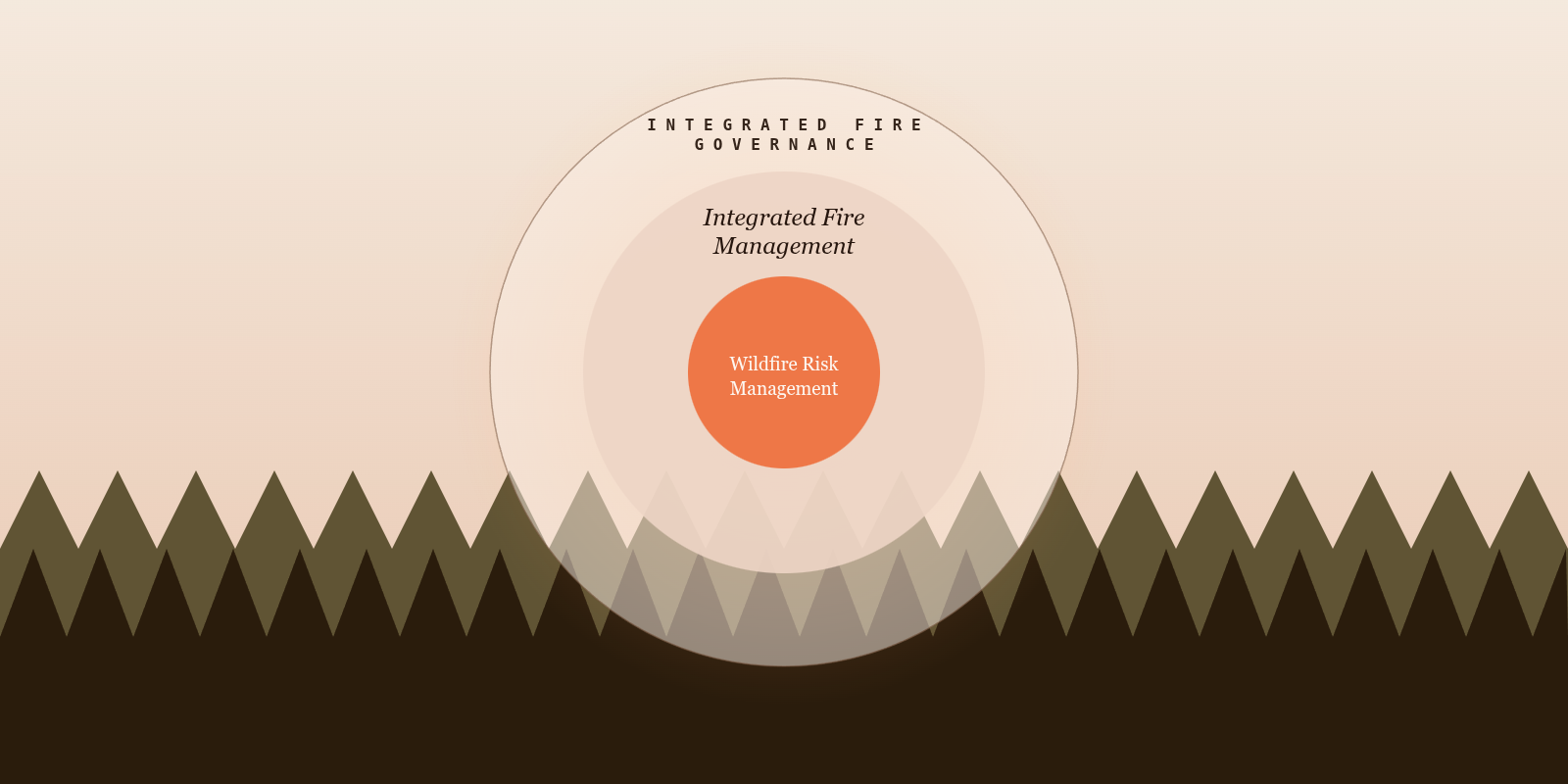
I am all for integration, namely, integrated fire management, and there’s clear distinction to be made: Integrated Fire Management, in the FAO lineage, restores fire's dual nature — tool and hazard — and brings the right actors to the table: pastoralists, foresters, ecologists, local and traditional fire practitioners, not only firefighters. Integrated Fire Governance, which I also deem necessary although not going deep into the matter here, goes one level further, from technique to institutions: who holds authority over fire, how it's distributed across society, how accountability and coordination are arranged (as a side note, this is where the Portuguese policy and vocabulary goes beyond the recommendation and the Commission’s communication: we’re working on governance).
In fairness, the Council/Commission’s choice is defensible, and possibly deliberate, on at least three grounds. That of competence, as land and forest management is largely a Member-State matter, so "wildfire risk" keeps the instrument safely inside the EU's civil-protection and disaster-risk mandate (though short...), whereas "fire governance" would reach into areas Brussels cannot direct; Mobilisation, since after a season with more than a million hectares burnt, threat-forward language moves money and attention in a way "governance" likely never will, and audience, as a Parliament-and-Council text runs on the risk–resilience–competitiveness register. The document even cites EASAC's work on a fire-literate and fire-adapted Europe3 — the coexistence paradigm I believe is very much needed — so the substance leans broader than the label, and one could argue the title is merely packaging. However, packaging has meaning, and might steer in a wrong or less-than-perfect direction.
Naming isn't packaging when the name selects the institution, the metric, the participants and the default response. Call it risk management and it lives in civil protection, counts burnt area as pure loss, seats firefighters, and defaults to suppression. Call it fire governance and it can sit above the line agencies, measure the right-fire/wrong-fire balance, seat land managers and communities, and treat suppression as one instrument among several.
Going through the document, considering the Landscape Fire Governance Framework4, and our own Portuguese experience, I’d say the cleanest correction isn't to swap one word for another — it's to nest them. Integrated fire governance is the institutional and political frame; integrated fire management is the operational doctrine inside it; wildfire risk management is one component, the hazard-reduction subset. The Communication takes the narrowest member of the set and uses it as the name of the whole. I would have been far happier with a very honest communication title “on integrated fire management” containing a wildfire-risk-reduction pillar — not the inverse.
I do consider this to be a very positive, and much needed step forward, but I question if the chosen title, in a fast-moving world where people just skim and seldom dive into matters, isn’t just getting us into the usual trap of suppression. I am all for integration, but not just of wildfire risk. All fire. All the value chain. All of society. A better title would have been a better sign, however integrated fire management is the way forward, and I welcome the Council and Commission into it.
- https://www.consilium.europa.eu/en/press/press-releases/2026/06/29/wildfires-council-adopts-recommendation-to-strengthen-preparedness-and-enhance-prevention/ ↩
- https://ec.europa.eu/echo/files/civil_protection/communication_on_integrated_wildfire_risk_management.pdf ↩
- https://easac.eu/publications/details/changing-wildfires ↩
- https://www.wildfire2023.pt/conference/framework ↩